Saturday, November 8, 2014

Augmented Reality Enlisted in the Fight Against Cancer

Written by Joe Stangarone


Often times in the treatment of cancer, surgical removal of a tumor is a necessary procedure. What a doctor wants to do in this situation is remove the tumor plus a small amount of healthy tissue that surrounds it. The latter is necessary so it is ensured that the whole tumor is removed. If even a small amount of the tumor is left behind, it can continue to grow and cause problems, and another surgery to remove what is left may be needed.

Tumor removal can be a very tricky procedure. Tumors are typically three-dimensional in form, irregularly shaped and may be in tough-to-reach places. All surgeons have to go on is what they can see and feel combined with what they can view on radiologic imagery.

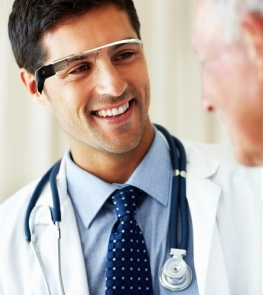
With an augmented reality enabled image guidance system being developed by Doctor M. Catherine Lee, however, surgeons will have a new and powerful tool to help them with the process. Working with Doctor Yanhui Guo, Doctor Lee and her team designed a software algorithm that utilizes radiologic imagery such as ultrasounds and mammograms, converting the data into three-dimensional digital images and displaying them on a screen. Then, in a surgical simulation, the researchers piped these images into a set of augmented reality enabled glasses, which allowed the surgeon to view an extremely accurate 3D representation of the tumor directly overlaid on the tumor itself. This could even be viewed before any incisions were made, giving the surgeon what basically amounts to x-ray vision, enabling them to study the problem at length with no additional risk to the patient.

This system has demonstrated its ability to greatly increase the accuracy, efficiency and safety of such tumor-removal procedures. It can be hoped that with wide-spread adaptation, this new technology will minimize the need for additional surgeries, decreasing the cost, discomfort and stress for cancer patients everywhere.

Wednesday, November 5, 2014

How Augmented Reality May Affect Your Health

 Written by Joe Stangarone


Augmented reality is set to change the ways people go about their daily lives. Greater convenience, greater safety, and easier access to more pertinent information are all things we can expect to experience. No exception to this is the field of health care - both in the personal and professional realms. As the technology of augmented reality becomes more and more sophisticated, there will be seemingly endless ways in which it will benefit both an individual's healthcare and the industry as a whole.

There are a number of ways augmented reality will benefit the health and well-being of an individual. Not least of which is making information about dietary choices more accessible. One other field of developing technology that will play a key role is the internet of things. Imagine yourself in a grocery store where every item is broadcasting information about itself to the nearby area. As you walk down the isle with your augmented reality-enabled glasses, information about each product appears next to it as a pop-up. Surely there wold be almost too much information to keep track of in one isle, but with filtering you could quickly find the information you need. You could say, for example, "Display only cheese ravioli." Once only the chosen items where being displayed, you could narrow it down further by saying something like "Display only the item with the lowest sodium." You could also pre set your device to only highlight items that fit a diet plan, or even have it sync automatically with your health records to help you avoid foods that may cause you trouble.

Augmented reality will also bring significant benefits to the health care industry as well. One area in particular would be the administration process. Wearing a pair of augmented reality enabled glasses, a hospital administrator could see a patient's information immediately and right in their line of sight, eliminating the need to ask for this information and filling out forms. This would greatly reduce the overhead associated with this process and lead to more efficient and accurate patient handling. This could also be cause for a more effective initial examination by a nurse or other health care practitioner. Wearing such a pair of glasses, the entire examination could be recorded - weather it be in the hospital or during a home visit. Also, a doctor could watch the live video, ask questions or request more information - essentially allowing him or her to be two places at once.

Within a hospital, and in particular areas where the staff is interacting directly with patients, augmented reality will bring significant improvements in the ever-important concern of safety. Tablets and desktop computers are already commonplace in hospitals, but they pose a danger in that the need hands to operate them. Great efforts are dispensed at hospitals to keep the spread of germs at bay, and cross contamination between staff and patients alike can be a real problem. With the use of desktops, hand-help devices and other medical devices, the very equipment the staff is using is a hot spot for such dangers. With the adoption of augmented reality enabled devices, such concerns will be greatly mitigated. For one, there can be a drastic reduction in communal usage of computer equipment because each member of the staff will be able to enter and retrieve information they need through their own device. No less importantly, surgeons will have all the information they need right in front of them, eliminating the need for them to have to go through the lengthy process of scrubbing out and back in again in order to use a tablet or desktop to access additional information. 

Health is important to everyone. Most individuals and the health care industry alike are always looking for ways to affect it more positively. Augmented reality and the devices that will bring it to life will almost certainly be a game-changer in this arena. And the good news is that the more sophisticated and capable the technology becomes, the more significant the improvements will be.

Monday, November 3, 2014

Living Maps in Alaska


Maps can be a teaching tool, as well as a way to inform communities about the landscape they live on. But flat, 2-D maps also aren't a highly engaging tool in and of themselves for the general public. What if you could control and change the map with just the swipe of your hand? A project at the University of Alaska is using geological data visualization technology developed at UC-Davis to create an augmented reality map that can educate and bring a community together.

By projecting an interactive map over a sandbox, this new tool allows people to engage with the map by getting their hands dirty, literally. If a user pushes sand into a mound, the projected map registers the mound of sand as a mountain, and accordingly changes its graphics to reflect the change in landscape. One project using the augmented reality map is using it to look at and document how the changing environment and landscape can impact the community living within it. 

Learn more about the augmented reality sandbox at the University of Alaska.

Photo by davecito from Flickr under Creative Commons.

Seeing Climate Change Up Close and Personal: A Better Way to Educate?


Educating large groups of people about complicated scientific issues - not an easy task. Climate change has proven to be one of the most challenging communication and education issues, and not just because of the political tug-of-war over the issue. How do you get people to invest time into learning about climate change, and take action, when a the concept and the call to save the planet can be so overwhelming?

Smithsonian.com looks at how augmented reality can measurably change a person's behavior after they experience the effects of environmental destruction through augmented reality or virtual reality. The way they experience this matters. If people feel a real sense of control over their actions, they are more likely to take action or change a specific behavior. For example, in an MIT augmented reality app, users are given the opportunity to see and experience the environmental impacts of policies, by "implementing" a policy, or "removing" a policy. In their augmented reality, they view the future effects of these policies immediately.

Of course, there are concerns that bias can creep into the way augmented reality experiences are designed, and many may argue that getting out in nature and appreciating the environment in actual reality is more appropriate. But for those that need to see the effects of climate change from a different perspective, augmented reality could provide a solution.

Read more about the many ways augmented reality is addressing the climate change education and communication challenge.

Photo by Nattu on Flickr under Creative Commons

Big Tackles...and Even Greater Empathy? Augmented Reality in the NFL and Beyond


What would it be like to experience an NFL player tackle you, head-on - how would this change your experience with the sport? And more than that, could experiencing what another person does change your mind? In a recent TED talk, Chris Kluwe, NFL punter and avid gamer, discussed the ways augmented reality can not only enhance the game, but also increase empathy around the world.

Kluwe is clear that the enhancements that real-time, in-context data could make to the game are incredibly exciting. Using this AR on the field would allow players to use data to make snap decisions on the field, and make different judgements than they may be making now. The implications of AR's potential in football are impressive: by changing the players' focus, will some players flourish in the augmented world, while others, who may have thrived in the traditional game, struggle?

As a vocal activist against bullying, homophobia, and sexism, Kluwe also believes that augmented reality can do more than provide a stream of data. He believes it also can help people develop greater empathy, by putting their minds and emotions in the virtual shoes of the persecuted. In his view, the technology could have a massive impact on the health of human society.

Wearing Google Glass and Stealing Passwords: A Part-Time Job


Wearing Google Glass and Stealing Passwords: A Part-Time Job

Written by Dan Cyr
Source: www/telegraph.co.uk
So your sitting in a coffee shop surfing off of the establishment’s free Wi-Fi. Un-denounced to you, there is someone sitting behind you watching your every move as you log in to your bank account and check your investments. 24 hours later you are wondering why your bank account is negative and you invested in an unknown company in Uruguay.
Cyber forensics experts at the University of Massachusetts have developed a way for Google Glass to capture touch screen interaction from just about 10 feet away. People with these glasses can video capture where you click on the screen and decode it upon further review. Google responded with their ability for people to notice when someone is recording since the glasses light up and reveal video is being recorded. My question to that is, when someone is sitting behind you, how are you supposed to notice this feature?
Watch the video embedded here and see how privacy is tested once again in this upcoming augmented world we will call reality.

Sunday, November 2, 2014

Current Market Survey for Wearable Augmented Reality Devices

Written by Joe Stangarone


Augmented reality is a field of technology still in its infancy. Aside from a few niche markets, it is something still very uncommon in the larger marketplace of consumer electronics. This, however, is likely something that will change sooner rather than later. 

Lately augmented reality devices have been getting a lot of press because of devices in development that users will actually wear some of - if not all - the time. The most mentioned in this category is indisputably Google Glass, which is the giant search-engine company's first device aimed at the wearable augmented reality market. Google Glass has yet to reach market in full-scale production, but the amount of media attention it has garnered would cause one to wonder if other companies are far behind with their own products. As it turns out, a few are certainly right on the heels of Google Glass with their own prototypes, and the following is a brief synopsis of some options out there.

OPTINVENT ORA
Similar to Google Glass in that it is a set of glasses using retinal projection technology to display data, the ORA-1 is the current developer's model. The company has a Kickstarter campaign in the works in order to develop a new model to take to the broader consumer market. Although very similar to Glass in functionality, the company claims their technology is superior in terms of viewing angle, screen size, contrast and power efficiency. Interestingly, the ORA has what is called "Flip-Vu", which enables the user to switch weather the display is directly in the line of sight or below it. With this , one can choose to have a more immersive experience or keep the info coming in contained to the sidelines. What may be most notable of all, however, is that the planned retail cost will be around $400 - almost a quarter of what the $1500 Glass is currently going for.

TOSHIBA GLASS
Toshiba's Glass is another set of eye glasses aimed at bringing data directly to a user's line of sight. It has an interesting feature in that the image is projected not onto a prism like Google Glass, but rather directly onto the lens of the glasses. In the lens are a set of narrow prisms that then reflect the image into the eye. By doing this, it is very difficult to see the equipment while looking at the lenses. However, it is not difficult to spot the device while looking at the frames. The display is not really its own computer but rather a projector that will be run by a user's smart phone. The glasses then will actually be connected to this phone by a cable out the back. This makes the glasses more of an extended display rather than their own device, and they are catching a little heat because of their non-wireless set up.

SONY SMART EYEGLASSES
Still in the development stage and hence not a lot known about it, the biggest differentiator for Sony's foray into the smart glasses market seems to be that it will have an integrated screen that will serve to be another display of the user's smartphone. Also notable is that Sony has been an electronic giant for a lot longer than some of its rivals in this market, and that is something they plan to leverage in terms of software and optic technology.

BAIDU EYE
Baidu is the Google of China, and they too are throwing their hat in the ring for a wearable device to rival  Google's Glass. Curiously, their version does not include a screen, but rather connects to the user's mobile device wirelessly. This was to extend battery life and increase comfort, the company says. In essence the built-in camera surveys the world around the user and relays any pertinent data about it to the user's mobile device via an app. The model is still in prototype stage and no price has yet been set.

EPSON MONVERIO BT-200
Epson's augmented-reality enabled glasses are one of the few if not the only to have a fully transparent screen mounted in from of each eye. Rather heavy in weight and clunky in appearance, this model is not targeted to the larger consumer market. Instead, it seems that Epson envisions this current iteration to be very useful in industry-specific applications, such as construction or maintenance and repair work.  
VUZIX M100
The Vuzix M100 is a stand-alone, wearable computer that mounts on to glasses or a headset. Similar in functionalities to many of its competitors, the main difference is that rather than projecting the display to a clear lens or prism, there is an actual, very small screen in front of the user's eye. The device appears to be fully adjustable so a user can position that screen to their liking, but it wouldn't have the see-through element that seems to be popular among similar devices. That being said, it does have a major advantage in being the only such device released to the consumer market.

Currently there are many different ideas being tested of how best to enable users to wear augmented reality devices. Being such a new technology, it is difficult for anyone to know what will be the best option, as only time will tell what makes the most sense for the average consumer in the real world. One thing seems to be certain however, and that is that many companies - big and small - believe that there enormous market potential with this technology. With that it is safe to say we all will be seeing a lot more of augmented reality in the future, wether or not its through our own glasses.