Showing posts with label health. Show all posts

Saturday, November 8, 2014

Augmented Reality Enlisted in the Fight Against Cancer

Written by Joe Stangarone


Often times in the treatment of cancer, surgical removal of a tumor is a necessary procedure. What a doctor wants to do in this situation is remove the tumor plus a small amount of healthy tissue that surrounds it. The latter is necessary so it is ensured that the whole tumor is removed. If even a small amount of the tumor is left behind, it can continue to grow and cause problems, and another surgery to remove what is left may be needed.

Tumor removal can be a very tricky procedure. Tumors are typically three-dimensional in form, irregularly shaped and may be in tough-to-reach places. All surgeons have to go on is what they can see and feel combined with what they can view on radiologic imagery.

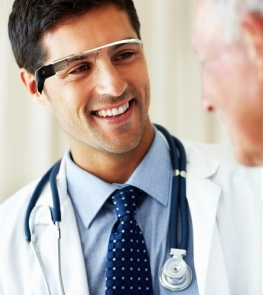
With an augmented reality enabled image guidance system being developed by Doctor M. Catherine Lee, however, surgeons will have a new and powerful tool to help them with the process. Working with Doctor Yanhui Guo, Doctor Lee and her team designed a software algorithm that utilizes radiologic imagery such as ultrasounds and mammograms, converting the data into three-dimensional digital images and displaying them on a screen. Then, in a surgical simulation, the researchers piped these images into a set of augmented reality enabled glasses, which allowed the surgeon to view an extremely accurate 3D representation of the tumor directly overlaid on the tumor itself. This could even be viewed before any incisions were made, giving the surgeon what basically amounts to x-ray vision, enabling them to study the problem at length with no additional risk to the patient.

This system has demonstrated its ability to greatly increase the accuracy, efficiency and safety of such tumor-removal procedures. It can be hoped that with wide-spread adaptation, this new technology will minimize the need for additional surgeries, decreasing the cost, discomfort and stress for cancer patients everywhere.

Wednesday, November 5, 2014

How Augmented Reality May Affect Your Health

 Written by Joe Stangarone


Augmented reality is set to change the ways people go about their daily lives. Greater convenience, greater safety, and easier access to more pertinent information are all things we can expect to experience. No exception to this is the field of health care - both in the personal and professional realms. As the technology of augmented reality becomes more and more sophisticated, there will be seemingly endless ways in which it will benefit both an individual's healthcare and the industry as a whole.

There are a number of ways augmented reality will benefit the health and well-being of an individual. Not least of which is making information about dietary choices more accessible. One other field of developing technology that will play a key role is the internet of things. Imagine yourself in a grocery store where every item is broadcasting information about itself to the nearby area. As you walk down the isle with your augmented reality-enabled glasses, information about each product appears next to it as a pop-up. Surely there wold be almost too much information to keep track of in one isle, but with filtering you could quickly find the information you need. You could say, for example, "Display only cheese ravioli." Once only the chosen items where being displayed, you could narrow it down further by saying something like "Display only the item with the lowest sodium." You could also pre set your device to only highlight items that fit a diet plan, or even have it sync automatically with your health records to help you avoid foods that may cause you trouble.

Augmented reality will also bring significant benefits to the health care industry as well. One area in particular would be the administration process. Wearing a pair of augmented reality enabled glasses, a hospital administrator could see a patient's information immediately and right in their line of sight, eliminating the need to ask for this information and filling out forms. This would greatly reduce the overhead associated with this process and lead to more efficient and accurate patient handling. This could also be cause for a more effective initial examination by a nurse or other health care practitioner. Wearing such a pair of glasses, the entire examination could be recorded - weather it be in the hospital or during a home visit. Also, a doctor could watch the live video, ask questions or request more information - essentially allowing him or her to be two places at once.

Within a hospital, and in particular areas where the staff is interacting directly with patients, augmented reality will bring significant improvements in the ever-important concern of safety. Tablets and desktop computers are already commonplace in hospitals, but they pose a danger in that the need hands to operate them. Great efforts are dispensed at hospitals to keep the spread of germs at bay, and cross contamination between staff and patients alike can be a real problem. With the use of desktops, hand-help devices and other medical devices, the very equipment the staff is using is a hot spot for such dangers. With the adoption of augmented reality enabled devices, such concerns will be greatly mitigated. For one, there can be a drastic reduction in communal usage of computer equipment because each member of the staff will be able to enter and retrieve information they need through their own device. No less importantly, surgeons will have all the information they need right in front of them, eliminating the need for them to have to go through the lengthy process of scrubbing out and back in again in order to use a tablet or desktop to access additional information. 

Health is important to everyone. Most individuals and the health care industry alike are always looking for ways to affect it more positively. Augmented reality and the devices that will bring it to life will almost certainly be a game-changer in this arena. And the good news is that the more sophisticated and capable the technology becomes, the more significant the improvements will be.

Monday, October 27, 2014

Augmented Reality's Effectiveness in Treating Phobias

 Written by Joe Stangarone


Augmented reality holds a lot of promise for the future in terms of convenience and productivity. It also stands to be very beneficial in many areas of medicine as well. Given augmented reality's immersive experience and ability to blend the real world with the virtual, the field of psychology will by no means be left out of the many benefits augmented reality has to offer.

One area of psychology in particular that may benefit from augmented reality is the treatment of phobias. Treating people with certain phobias can be a daunting task. This is especially true when it comes to dealing with phobias that involve insects or other animals. Treatment at some point will involve exposure to the phobia, and in the case of live animals, that exposure can be difficult to control. Animals, especially insects, can be very unpredictable. Because of this, therapist can run into trouble during the exposure phase of treatment - which can be a critical time for the patient's progress in overcoming their phobias. The animals may not act in the patient's best interest and there is a real element of danger for the patient in some cases. Furthermore, the exposure can involve gaining access to difficult or impossible places to reach, or the exposure sometimes may have to be in a public setting. All of which can make this portion of the treatment more difficult than it needs to be.

Fortunately, augmented reality can help mitigate all these issues, as a promising program developed by M. Carmen Juan, Mariano Alcañiz, and Carlos Monserrat at the Universidad Politecnica de Valencia, Cristina Botella at the Universitat Jaume I and Rosa M. Baños and Belen Guerrero at the Universidad de Valencia has shown. With this program therapists were able to overlay virtual insects upon the real world. Not only were the therapists able to control the number and actions of the virtual insects, they were able to do it in the environment of their choosing with no danger introduced to the patients. This augmented reality system also holds an advantage over fully virtual reality systems because with it the patiences see their actual hands, arms and surrounding environment. Because of this, the experience of being exposed to their virtual phobias feels more real, hence advancing the treatment more efficiently.

This program holds a lot of promise for the future treatment of phobias. This was stated not only by the individuals responsible for its design, but by the patients as well. Anxiety scores were greatly lowered after the treatment, and the time needed to reduce the patient's fear was shorter than other VR experiments. Furthermore, a questionnaire filled out by all patients in the study showed that they felt completely immersed in the experience, with feelings of anxiety equal to what they would have experienced had the insects been real.

Augmented reality is a technology in its infancy and  is already showing great potential for the treatment of phobias. With this and other areas of health, it is not hard to predict that augmented reality has the potential to make the real world a better place for many people.